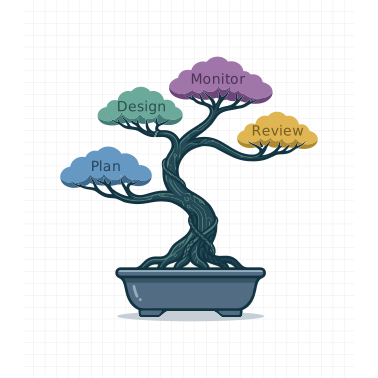
Plan
Goals, constraints, brainstorming with feasibility signals, issue board, and configured ADUs.
Bounded Orchestration Nexus for Structured Agentic Integration
BONSAI replaces unconstrained code generation with bounded orchestration across a four-layer stack—so VA systems stay modular, traceable, and under expert control.
The Challenge
Fast prototyping is valuable—but “vibe coding” loses the causal thread. BONSAI is built around three non-negotiables:
Hard boundaries between layers and services so teams can scale and reuse without entanglement.
Agents run with explicit scopes, validated interfaces, and guardrails—automation that respects architecture.
Decisions and handoffs are first-class events: a legible trail from intent to deployment.
The Bonsai Core
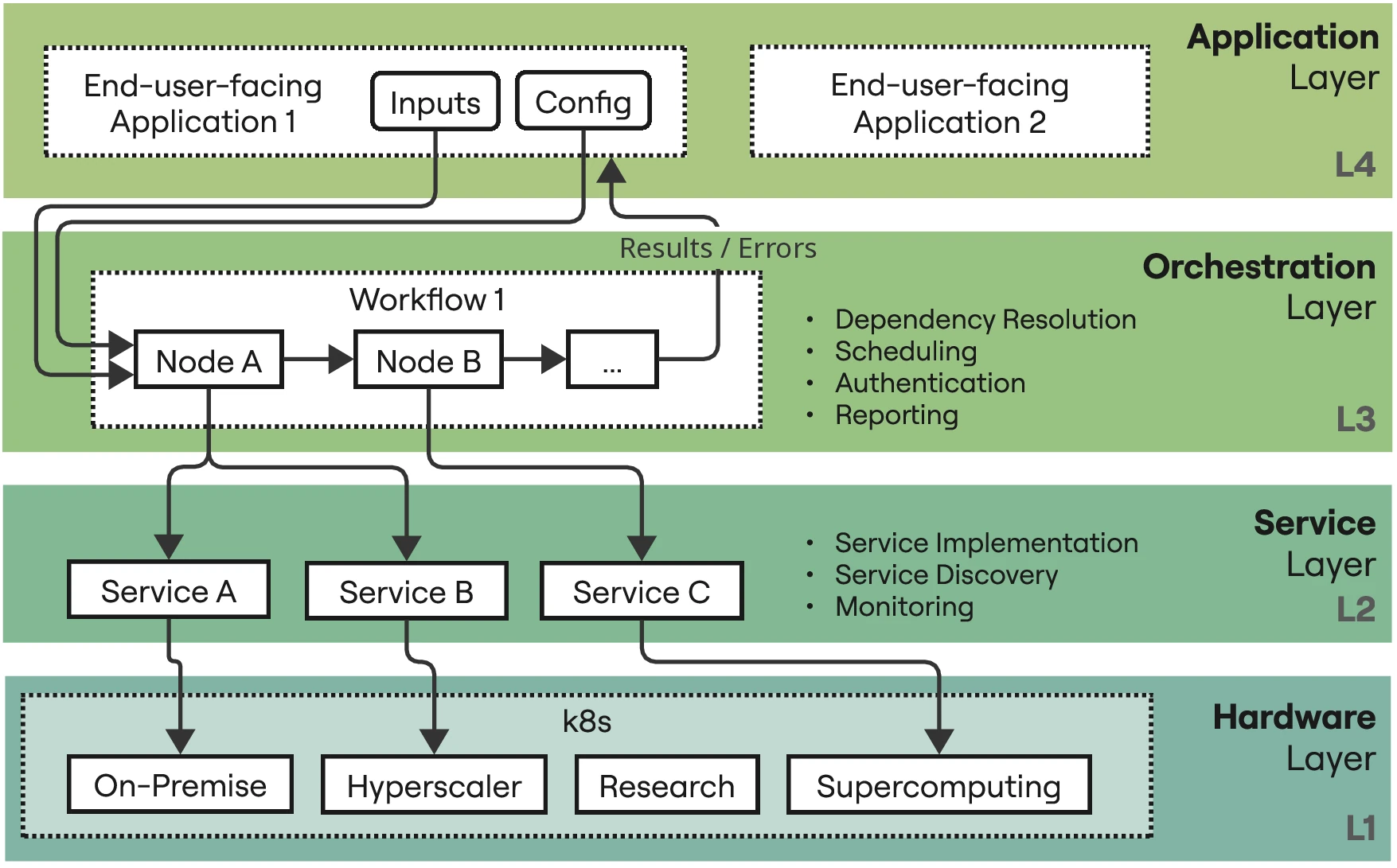
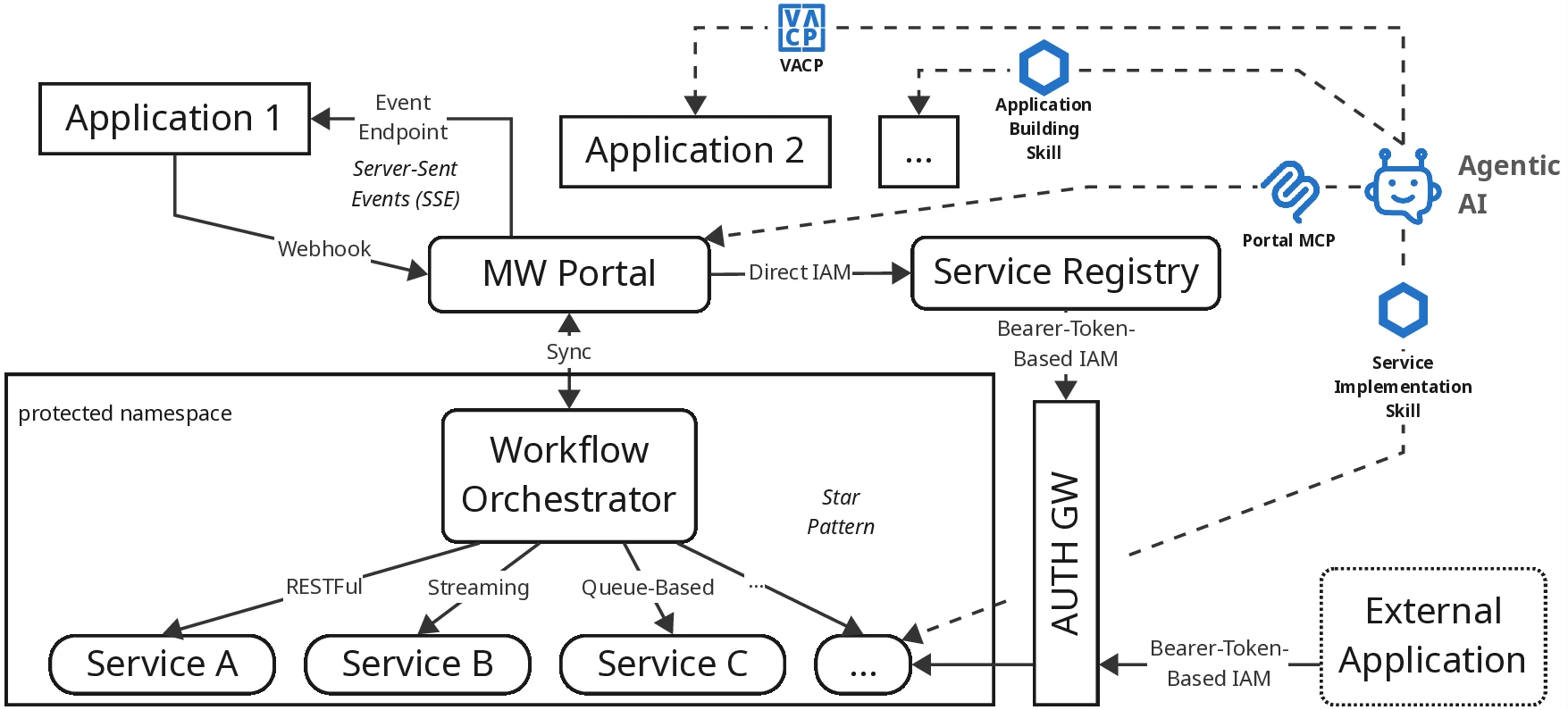
The stack in one glance: what users see on top, how work is coordinated in the middle, and how compute is pooled and governed at the bottom.
This is the face of your tool: charts, controls, and guided steps where analysts work, while the platform runs the pipelines behind the scenes.
Here multi-step workflows are stitched together, executed in a sensible order, and updated when inputs change—without you micromanaging every handoff.
Small, focused pieces each do one job and plug in the same way everywhere, so teams can reuse work instead of rebuilding the same logic in silos.
Office machines, cloud capacity, and heavy-duty clusters are treated as one pool, with clear rules so sensitive runs stay in the right environment.
The Workspace
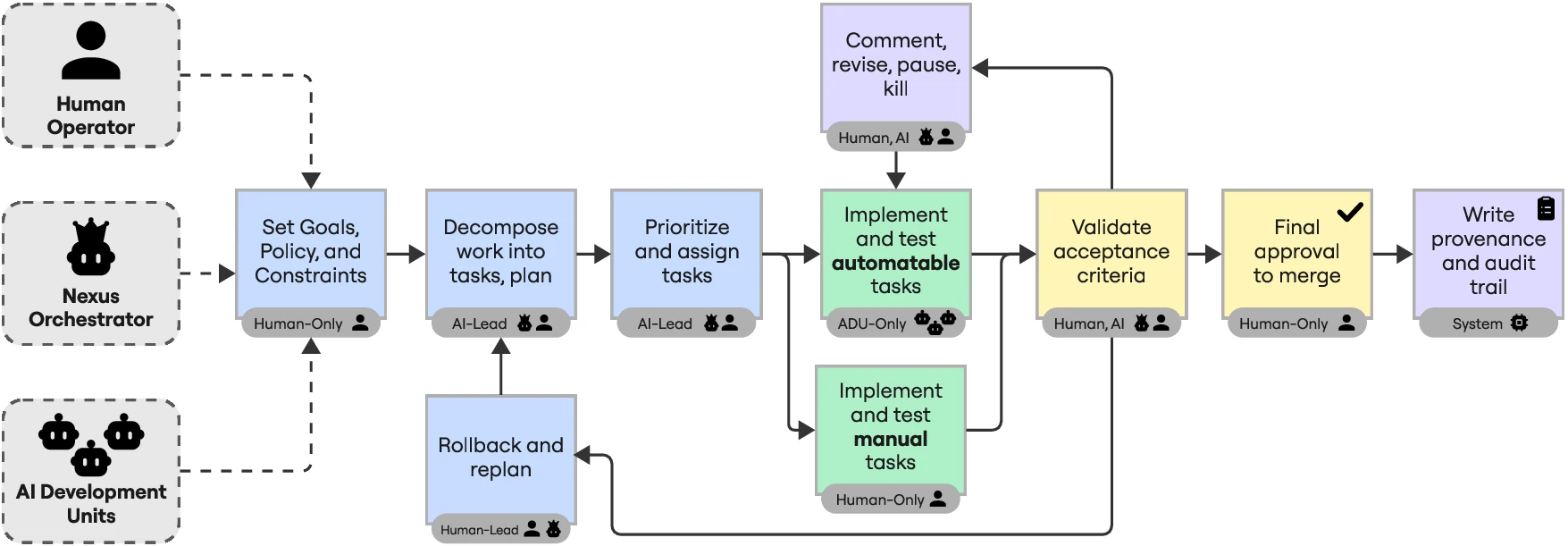
A mixed-initiative loop: humans set goals and policies; the orchestrator decomposes work and delegates to specialized units.
Goals, constraints, brainstorming with feasibility signals, issue board, and configured ADUs.
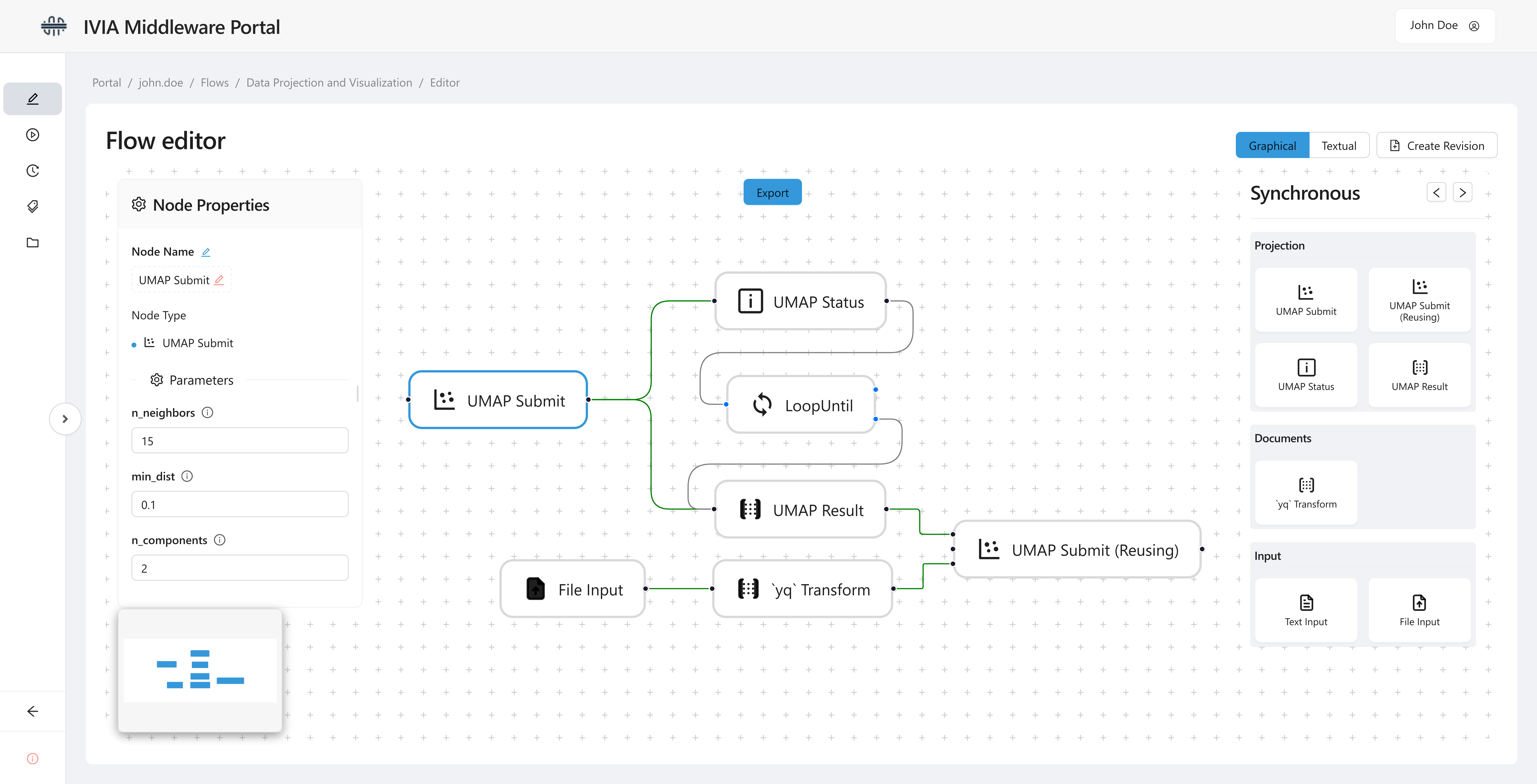
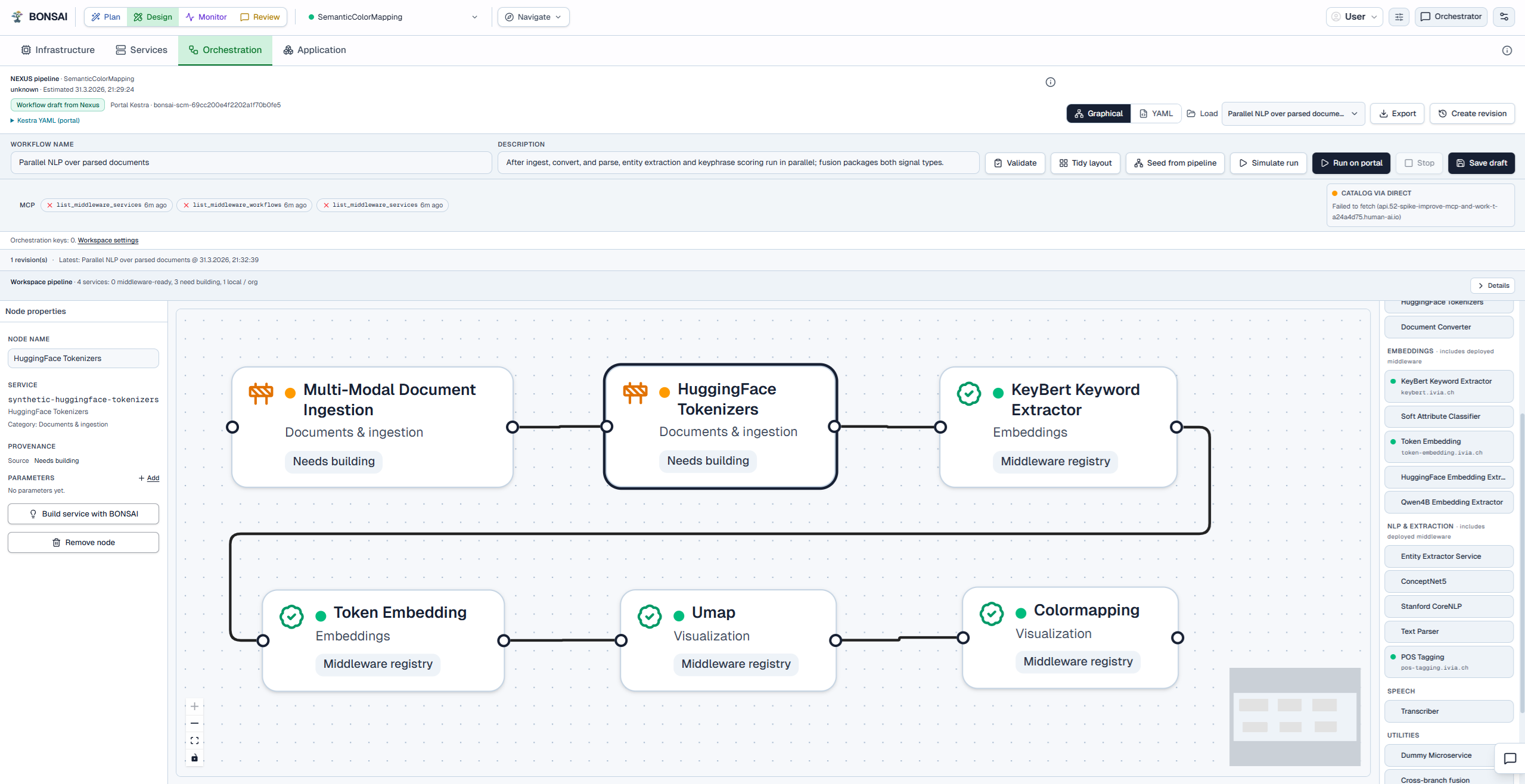
Service registry, typed pipeline editor, application view—new services become nodes without downtime.
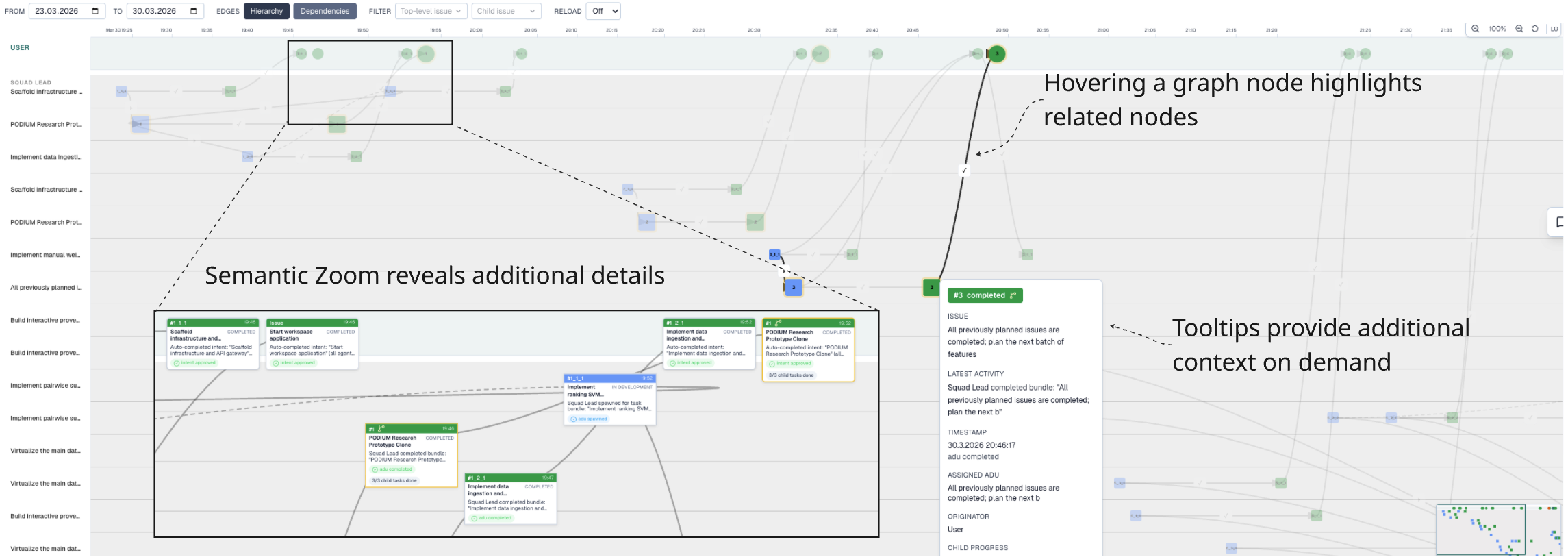
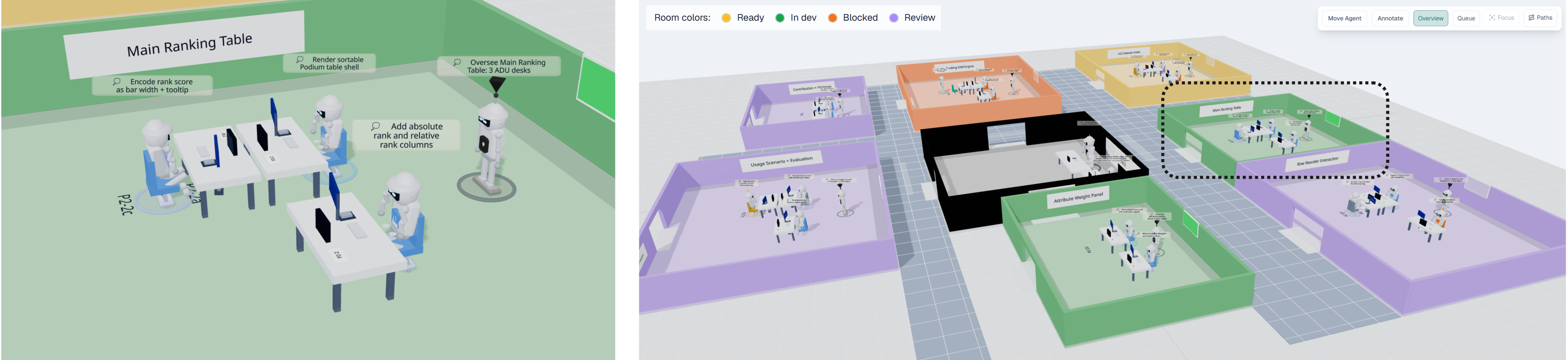
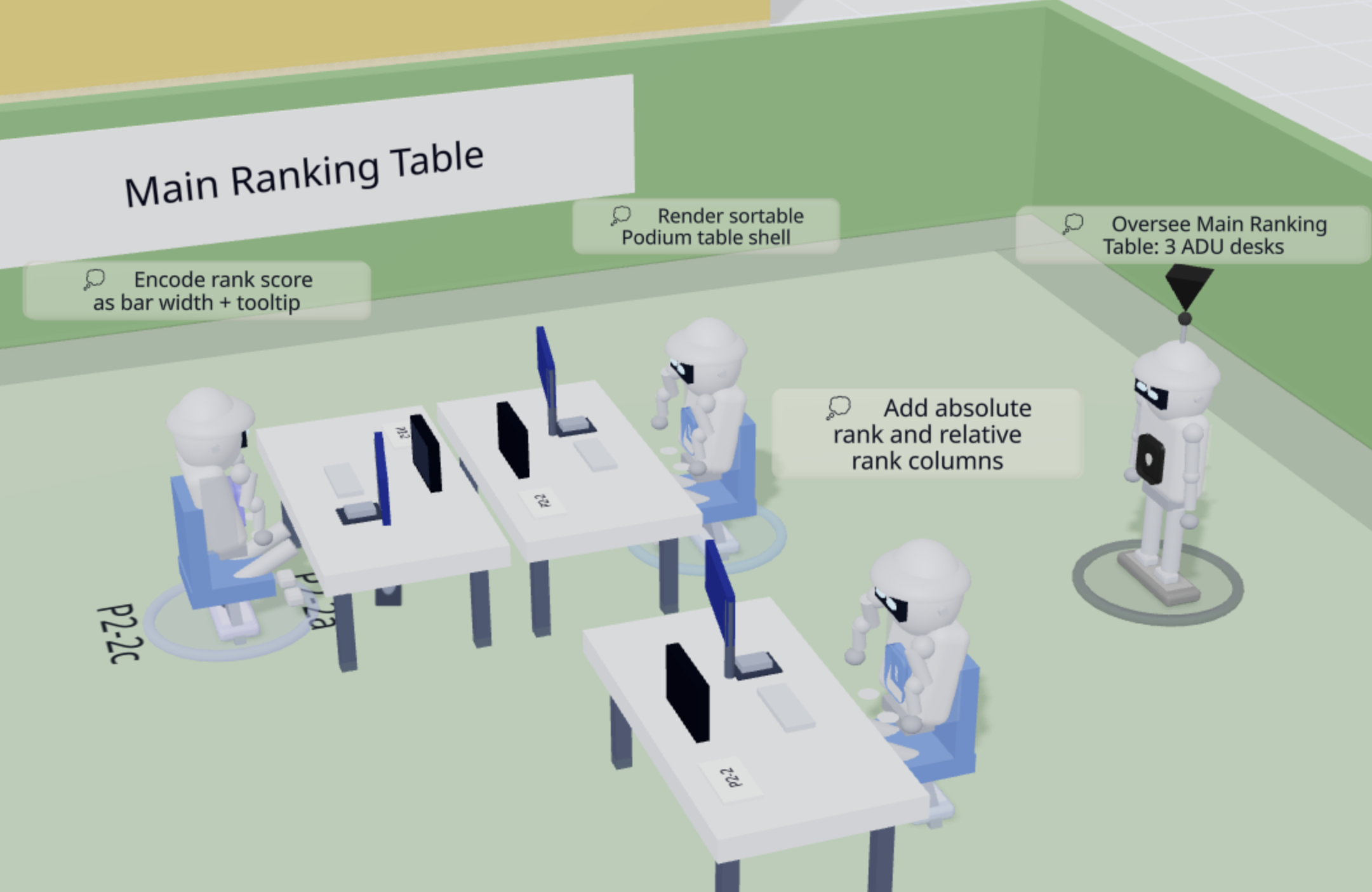
Agent map plus provenance with semantic zoom—every handoff is observable.
Merge-gated progress, live preview, and issues filed straight from the running prototype.
In Monitor, a provenance graph and a spatial agent map make progress and dependencies legible—zoom from the big picture into individual tasks.
AI Integration
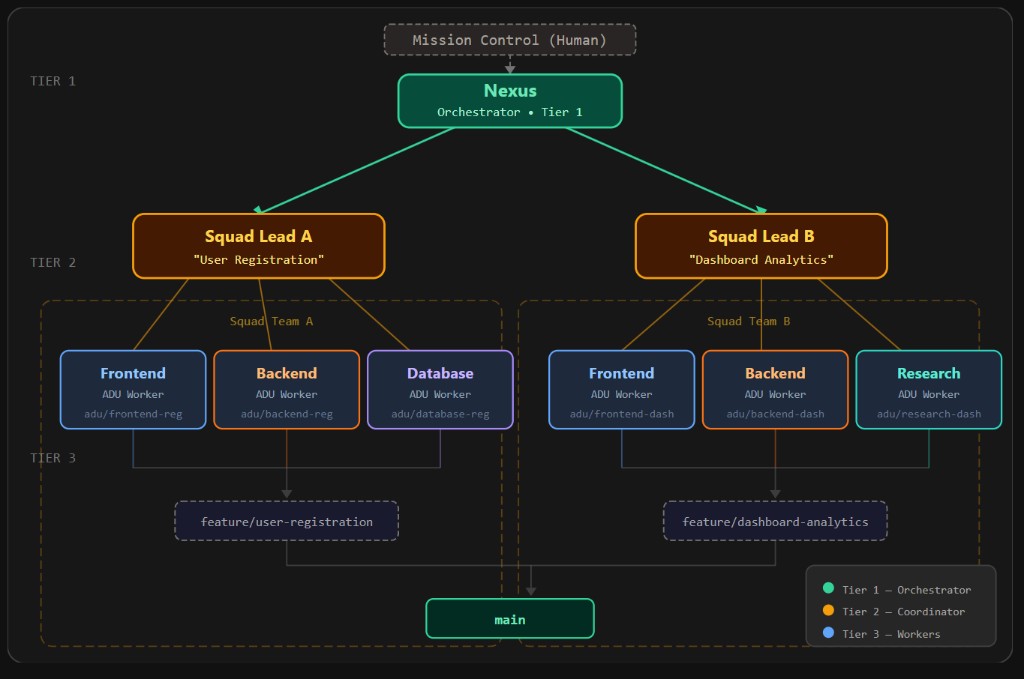
Three tiers mirror how serious software teams actually ship.
Dialogue → typed intents, backlog, policy gates, and service mining before spawning new work.
Split issues, acceptance criteria, and a tight plan → clarify → declare → implement loop with rework queues.
Specialized agents, one layer each, isolated branches, scoped task packs—no shared working context.
main.Validation
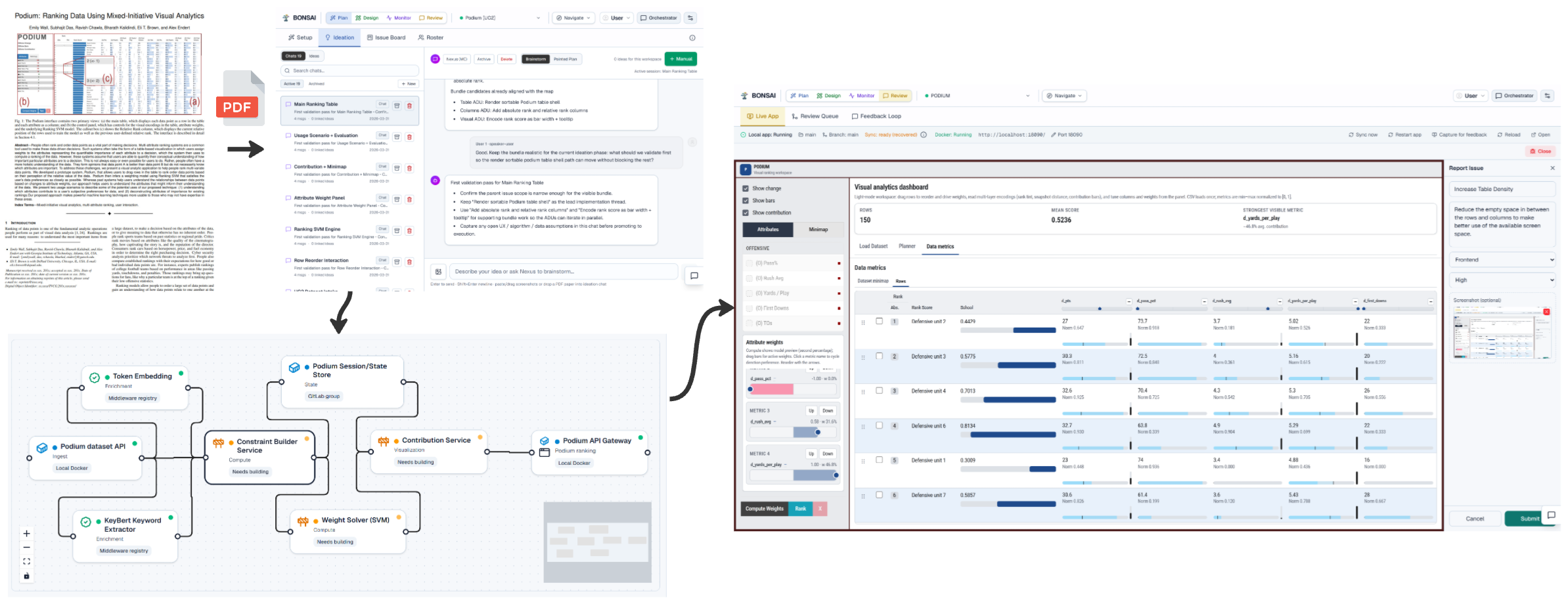
We evaluate BONSAI with two longitudinal case studies: real visual analytics work spans weeks or months, not a single controlled session. Semantic Color Mapping stresses catalog reuse—Nexus composed microservices into a DAG, CType exposed a field-level schema mismatch between stages, an adapter fixed it, and two ADU cycles produced an end-to-end pipeline without new services. PODIUM had no catalog fit, so the system was split into independent CType-aligned services built from scratch: a modular teaching prototype that underscores how costly interface changes become once OpenAPI contracts are fixed downstream.
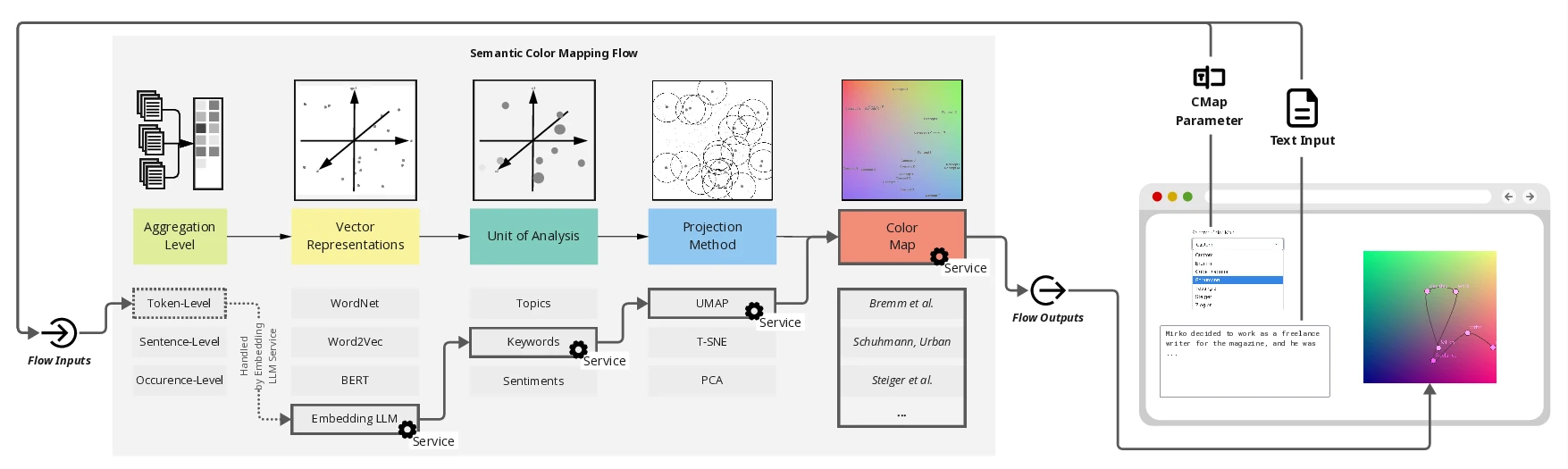
Mennatallah El-Assady, Rebecca Kehlbeck, Yannick Metz, Udo Schlegel, Rita Sevastjanova, Fabian Sperrle, Thilo Spinner. Semantic Color Mapping: A Pipeline for Assigning Meaningful Colors to Text. 2022. IEEE Workshop on Visualization Guidelines in Research, Design, and Education (VisGuides). DOI
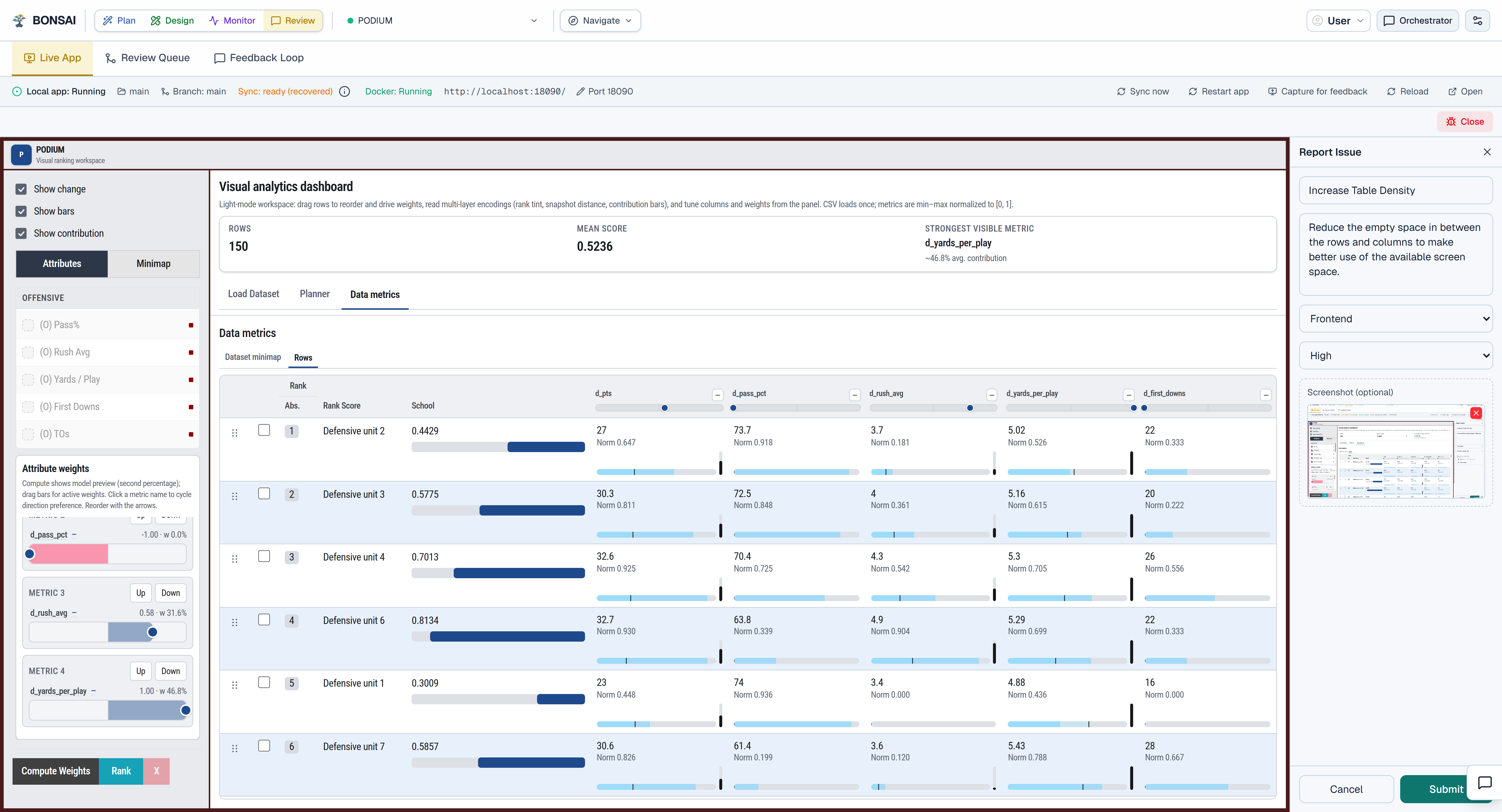
Emily Wall, Subhajit Das, Ravish Chawla, Bharath Kalidindi, Eli T. Brown, Alex Endert. Podium: Ranking Data Using Mixed-Initiative Visual Analytics. 2018. IEEE Transactions on Visualization and Computer Graphics, vol. 24, no. 1, pp. 288–297. DOI
Gallery
Extra visuals for the concepts on this page—architecture, workflow, and validation examples.
Sustainable multi-agent development needs structure and oversight—like the tree it’s named for. Join the waitlist for early access.
